The course wass organized along three main steps in the scientific cycle: (i) asking questions; (ii) executing research to answer these questions; and (iii) formulating the answers. It showed how scientists have been playful and creative in those steps, and stimulated us to find our own ways within science and to be playful. To achieve this, it explained that scientists are less restricted to all kinds of rules than is often thought-and-taught, and sometimes produce outputs other than scientific articles. Teaching was based around many inspiring examples of unconventional research questions, methods and output.
The coat colour conundrum
Do chickens trust red or blue coats more?
Type 1 project
Jeantine van Leeuwen & Dailenn Thieme
S3198774, s2650800
Do you have a favourite colour? Chickens do too. Chickens are tetrachromatic (Osoria et al, 1999), while humans are trichromatic, which means that chickens can distinguish more colours than humans. Since humans have clear colour preferences (Eysenck, 1941; Hurlbert & Ling, 2012; Lee et al., 2013), researchers have wondered if chickens do too. The short answer is yes! Studies show that chickens prefer blue and green-blue light over red and red-yellow light (Sultana et al., 2013; Prayitno et al., 1997) and orange and red objects over blue and green objects (Ham & Osorio, 2007).
Not only the light, but also the colour of garments can influence chickens’ responses. Studies have found that different coloured clothing influences the fear and stress response, and the meat quality of broiler chickens. Green proved to be more stressful than red, blue, and grey (Fidan et al., 2014), but later research has proven that red also has a stressful effect (Fidan, 2019). The effect of colour has also been investigated in laying hens, where dark clothing induced stress and noise, and green, yellow, and red were found more secure (Genc & Ozenturk, 2024). It is also known that chickens likely cause a disturbance when humans wear a different style and colour of clothing than they are accustomed to (Barnett et al., 1993; Hemsworth et al., 1994).
Most research on the responses of chickens based on colours measures fear and stress, but it does not measure trust or happiness. This is logical, as most research is done on broiler and laying chickens, which are kept with the intent of profit. The meat quality and egg quality and quantity can be affected by fear and stress (Fidan et al., 2014; Fidan, 2019; Fouad et al, 2016; Jones, 1996), but trust is not an important factor in business models. However, some researchers, like us, are interested in trust.
Chickens are incredibly fun to play with. Unfortunately, the chickens I was close with when I was younger are no longer around, and the new chickens are too skittish to approach. Animals are likely to grow more trusting as you spend more time around them (Iqbal, 2018). However, since I do not have a lot of time nowadays, we intended to find a more creative way to gain the trust of these chickens. As mentioned above, chickens discriminate between colours, so we decided to investigate whether the colour of your coat could influence the approach or trust by chickens. We hypothesise that the chickens would trust a red coat more than a blue coat, as they prefer red objects (Ham & Osorio, 2007) and red clothing (Genc & Ozenturk, 2024). In addition, the chickens normally get their food and water out of red basins, which means they might associate this colour with nourishment.
Methods
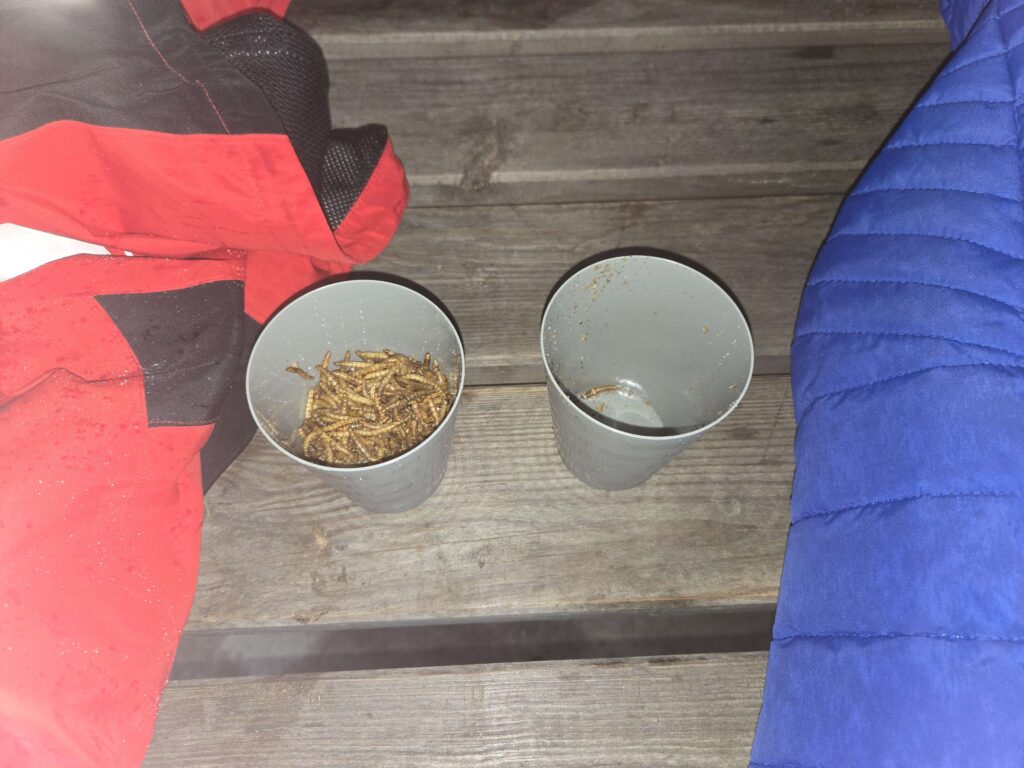
This study utilised a controlled experimental design to investigate the effect of different coloured coats on the approach and familiarity of (non-broiler) chickens. Two researchers were seated on both sides of the coup face to face holding mealworms in their hands. Both had a beaker full of mealworms to supply their hands. If the supply beaker was fully empty, or if around ten minutes of pecking had passed, the session ended. The researchers wore a blue and a red coat, which they switched every day to make sure any preferences the chickens show is for the coat instead of the wearer. All other clothing was black, and their hair was tied up to limit confounding variables. The shoes of the blue coat wearer were dark blue, as there were no two fully black pairs of shoes available. The researchers wore black leather gloves to prevent any pain reactions if the chickens accidentally bit the skin while feeding.
Four sessions were conducted over four days. All sessions took place in the afternoon with similar circumstances, except for the fourth session when it rained. The sessions were recorded with two phone cameras opposite each other. The chairs and cameras were placed while wearing a black coat to eliminate a familiarity bias. Afterwards, a researcher manually counted the number of pecks recorded during the sessions. The videos were slowed down to ensure accuracy as one chicken—the top-ranking chicken—was pecking so quickly counting on normal speed was impossible. The number of pecks was used as a proxy to determine which coloured coat will make you more approachable and trustworthy for a chicken.
Participants
A total of ten chickens were present at the experiment, but only three actively participated and dared to eat out of the researchers’ hands. There were also two ducks and a goose present, which did not interfere with the experiment as these were highly skittish and remained at a distance. The chickens are familiar with humans, as they are fed daily, but are not used to direct or prolonged contact. The caretakers normally wear personal clothing, no uniform or colour consistency. The chickens have a permanent supply of water and chickenfeed in their coup, and get daily food scattered for mental stimulation. Occasionally, they get a treat such as mealworms. The chickens at the time of the experiment are kept in a smaller coup due to a virus outbreak and had not received any mealworms in the days leading up to the experiment.
Results and discussion
Results were taken for both red and blue coloured coat over four days. From day two on, the chickens appeared to be waiting for the researchers in hope of more mealworms. However, they shot away from the entrance as soon as a researcher entered. Table 1 shows the results of the experiment, which are also visualised in Fig. 1. There is a trend between the variables, as blue outnumbered red every session, sometimes quite far. However, a paired-samples t-test indicated that there was no significant difference between red (M=413.5, SD=211.9) and blue (M=,721.5, SD=122.9), t(3) = -2.5, p = 0.09.
This trend aligns with the findings that chickens prefer green-blue light over red (Sultana, 2013), but not with the findings that chickens prefer red objects over blue ones (Ham & Osorio, 2007). Our hypothesis that the red coat would be more trustworthy than the blue one is not supported by these findings. This could be since we based our hypothesis on the response of chickens towards objects and their (negative) fear response towards clothing, instead of a positive response like trust. Because absence of fear does not necessarily correspond to trust, the findings based on which colour induces fear should not directly be translated into the effects of colour on trust.
Birds generally respond to new stimuli with a mixture of curiosity, aversion and indifference (Greenberg & Mettke-Hofmann, 2001). It is possible that the colour blue sparked more curiosity in the chickens than the colour red, as they are more familiar with red from the red food and water basins. This can also possibly explain why three chickens dared to peck, while the others did not. The curiosity of the latter could be lesser than their apprehension. One other explanation could be that the chickens have a strong pecking order (Guhl, 1956). If the top-ranking chicken preferred blue, the others might have followed. In fact, the recordings show that the most often and longest pecking chicken is high in the pecking order. This could have influenced the behaviour of the other chickens as they would have followed the top-ranking chicken and chosen the same, blue coat.
Limitations and further research
This study was constrained by a few limitations. One such limitation was that the environmental factors were not rigorously controlled in this small experiment. The time of the day was early in the afternoon, but not meticulous on the same time every session, due to other obligations of the researchers. The weather also fluctuated, which could have influenced the behaviour. Unfortunately, due to the size of this study, we cannot draw any definitive conclusions. No statistical effect was found, which could likely be caused by the very small sample size, which reduces statistical power. Further research could be done with a larger sample size, possibly a longitudinal study, with more controlled environmental factors and a larger colour range.
Conclusion
Chickens show clear colour preferences in a multitude of settings. We investigated whether chickens have a colour preference when approaching a human and building trust, based on the colour of a human’s coat. We did not find a significant difference between wearing a red coat and a blue coat. However, there was a trend that suggested chickens are more likely to approach a blue over a red coat. We suspect that if our sample size was bigger, this trend would have resulted in a statistically significant result. In conclusion, if you wish to speed up the trust gained from a chicken, we recommend wearing a blue coat over a red one.
Acknowledgments
Many thanks to Mrs. Thieme-Krüs for her help with the experiments. In addition, thanks to Het Dierenplein, Schijndel for letting us play with their chickens.
Bibliography
Barnett, J. L., Hemsworth, P. H., & Jones, R. B. (1993). Behavioural responses of commercially farmed laying hens to humans: Evidence of stimulus generalization. Applied Animal Behaviour Science, 37(2), 139–146.
Eysenck, H. J. (1941). A critical and experimental study of colour preferences. The American Journal of Psychology, 54(3), 385-394.
Fidan, E. D. (2019). Relationship in broiler breast meat quality and some blood parameters: Implications of different colours clothes and visual human contact. Iranian Journal of Applied Animal Science, 9(2), 323–328.
Fidan, E. D., Turkyilmaz, M. K., & Aypak, S. Ü. (2014). Effect of differently coloured clothes on fear and stress responses, some meat quality traits and performance in broilers. Italian Journal of Animal Science, 13(3), 3453.
Fouad, A. M., Chen, W., Ruan, D., Wang, S., Xia, W. G., & Zheng, C. T. (2016). Impact of heat stress on meat, egg quality, immunity and fertility in poultry and nutritional factors that overcome these effects: A review. International Journal of Poultry Science, 15(3), 81.
Genc, M., & Ozenturk, U. (2024). The effect of worker clothing color on stress in laying hens. Archives Animal Breeding, 67(2), 145–151.
Guhl, A. M. (1956). The social order of chickens. Scientific American, 194(2), 42–47. http://www.jstor.org/stable/26171734
Ham, A. D., & Osorio, D. (2007). Colour preferences and colour vision in poultry chicks. Proceedings of the Royal Society B: Biological Sciences, 274(1621), 1941–1948.
Hemsworth, P. H., Coleman, G. J., Barnett, J. L., & Jones, R. B. (1994). Behavioural responses to humans and the productivity of commercial broiler chickens. Applied Animal Behaviour Science, 41(1–2), 101–114.
Hurlbert, A., & Ling, Y. (2012). Understanding colour perception and preference. Colour Design (pp. 129-157). Woodhead Publishing.
Iqbal, S., Siddiqui, G. F., & Iqbal, M. Z. (2018). Modelling Trust Developing Procedure between Pet and Owner. 2018 14th International Conference on Emerging Technologies (ICET) (pp. 1-6). IEEE.
Jones, R. B. (1996). Fear and adaptability in poultry: insights, implications and imperatives. World’s Poultry Science Journal, 52(2), 131-174.
Lee, S. M., Lee, K. T., Lee, S. H., & Song, J. K. (2013). Origin of human colour preference for food. Journal of Food Engineering, 119(3), 508-515.
Osorio, D., Vorobyev, M., & Jones, C. D. (1999). Colour vision of domestic chicks. Journal of Experimental Biology, 202(21), 2951-2959.
Prayitno, D. S., Phillips, C. J., & Omed, H. (1997). The effects of color of lighting on the behavior and production of meat chickens. Poultry Science, 76(3), 452–457. https://doi.org/10.1093/ps/76.3.452
Sultana, S., Hassan, M. R., Choe, H. S., & Ryu, K. S. (2013). The effect of monochromatic and mixed LED light colour on the behaviour and fear responses of broiler chicken. Avian Biology Research, 6(3), 207–214.