In this course, we learned how to design and conduct a game-based research project that involves either the modification of an existing video game, or the purposeful development of a new interactive experience. In the process, we learned about existing ‘serious game’ projects, recent developments in game research more generally, and technological affordances that can be used in video games and interactive experiences.

Natural Mapping and Adaptation in Video Games
DAILENN THIEME, MARIA KAPUSHEVA, ALETTE FARZAD, SARA SPASIKJ, OVEIS SHABANI, and SHUBHAM GUSAIN,
Leiden University, The Netherlands
Motor adaptation is a key research field when it comes to improving accessibility, human-computer interaction, and skill training. Video games in particular prove themselves a valuable testing ground for motor adaptation, with them offering an extra layer of control over experimental variables. Our research aims to bridge the gap in the literature regarding control mapping configurations by investigating how easily players would adapt their motor control when keyboard controls are changed from their default mapping within the platformer game Celeste [1]. Furthermore, we look at whether previous experience with games influences the process of adaptation. We held an empirical study in which we invited 32 participants with mixed gaming experiences, and they played three rounds with different control configurations. The results indicated that while experienced gamers, on average, performed better (fewer deaths, less time spent), non-gamers adapted slightly quicker to a changed control scheme, suggesting that gamers established motor habits that hinder them from adapting to this rapid remapping. We theorize that adaptation advantages might depend on the genre of video game. These results open a direction for studying motor adaptation in a slower, planning-oriented environment. Additionally, they offer implications for the design of training systems or interfaces that require users to adjust to unexpected remapping.
Additional Key Words and Phrases: video games, motor adaptation, control configuration, natural mapping, celeste
ACM Reference Format:
Dailenn Thieme, Maria Kapusheva, Alette Farzad, Sara Spasikj, Oveis Shabani, and Shubham Gusain. 2026. Natural Mapping and Adaptation in Video Games. In . , 13 pages.
1 INTRODUCTION
Motor learning is a fundamental aspect of learning new skills, referring to the process by which practice or experience leads organisms to develop stable movement. Motor adaptation is a type of motor learning that refers to the learning of previously known motor skills in the presence of additional challenges [24]. Specifically, a key part of motor adaptation is error-making and correcting internal models. One might imagine a scenario, such as a person losing a limb or a person adjusting to new tools or technology, in which the internal model needs to be recalibrated to account for changes in movement. Motor adaptation, therefore, is fundamental when it comes to improving accessibility, human-computer interaction, and skill training.
Research in the field of motor adaptation can be traced back centuries. A famous study by Stratton in 1896 [23] investigated the consequences of inverting the visual field of participants. The researcher wore a device for about 21.5 hours over 3 days that inverted the visual field (for the remaining hours, a blindfold was worn). It was reported that gradual adjustment to the inverted vision occurred over the days and that even the mental representation of objects outside of the present field of vision corresponded with the newly inverted perception. Notably, the moment the equipment was removed, normal vision returned almost instantaneously. This research has inspired other similar studies, such as [11], and [7], but also others with a different application, such as, sensorimotor adaptation in speech [8], and sensorimotor adaptation on a larger scale [25].
With recent technological improvements, video games have become increasingly appealing to use as a testing ground to investigate motor adaptation (e.g. [13] & [3]) as opposed to controlled laboratory conditions. They offer an extra layer of control over experimental variables while simplifying complex problems into a controlled setting [10]. Furthermore, the engaging nature of video games has been shown to have the potential to be motivational for research participants, especially when compared to traditional experimental tasks [15].
Research in motor adaptation using video games often looks at the comparison between experienced video game players (gamers) and individuals with little to no video game experience (non-gamers) [6] and [9] compared adaptability to novel motor behaviours on action games using a tracking task. They found that experienced gamers had no initial advantage in performance, but that their experience did enhance the process of adapting to certain types of novel motor behaviours over time. A different study by [4] investigated cognitive flexibility between gamers and non-gamers by having participants perform on a task switching paradigm through a first-person shooter game. This study found similar results where gamers showed greater cognitive flexibility than non-gamers.
Platforming games, usually referred to as platformers, are a genre of game focusing on player movement in which a player is tasked to navigate environments by moving across platforms or obstacles. To challenge the player, good timing and precision are often required to traverse the environment. In platformers, players are generally given access to abilities such as jumping or climbing to diversify the options for traversal. These highly specific actions tend to be mapped to relatively few buttons. For example, in Super Mario Bros [16], players are merely required to use six buttons: the directional pad to move, A to jump, and B to run or use other abilities. Additionally, within platformers, a good button configuration is vital for a good player experience due to the input-heavy nature of the genre. Therefore, to ensure controls are intuitive, natural mapping should be kept in mind. Natural mapping refers to “a design in which the system’s controls represent or correspond to the desired outcome. When controls map to the actions that will result, systems are faster to learn and easier to remember” [17], but most research focuses on controller shape and movement rather than button configuration ([21]; [19]; [12]; [14]).
The focus on movement-heavy gameplay and the relevance of a good button configuration within platformers raises this particular genre of video game as an interesting ground to test motor adaptation. Despite this, limited research on adaptability has been done using platformers. Research by [5] did investigate players’ adaptation to new and non-standard controls. Experienced PC gamers were instructed to play a puzzle game specifically developed for this research using a standard XBOX controller, yet no instructions were provided regarding the button configuration of the controller, requiring players to investigate it themselves. The authors also note that there is a huge gap in the literature when it comes to the relationship between controllers, players’ adaptability, and gameplay.
1.1 Our Research
Another area of research missing within the literature is the adaptation of button configuration on a keyboard, rather than that of a handheld console. Inspired by the research mentioned earlier by [23], we wondered how easily players would adapt their motor control effectively when the keyboard controls are changed from their default state, similar to the original study. Within this field of interest, video games are particularly interesting as, despite the wide variety of video game media and genres, game designs often employ similar control mappings, e.g., movement is often bound to the arrow keys or WASD (see 6 for frequent key mappings in platform games). This means a default natural mapping is present, especially for those who regularly play games and therefore are used to these default control mappings. While existing studies have explored how motor adaptation affects video gaming experience [9], as well as switching costs with regards to cognitive flexibility tasks performed by gamers [4], it still remains unclear how specifically control mapping affects adaptation in video games. Platformers in particular offer a very suitable environment for studying this, as actions and controls are typically standardized and limited as previously discussed. Therefore, the purpose of this study is to investigate how players playing a platformer would adapt their motor control when the mapping of keyboard controls is swapped. In particular, we investigate whether experienced gamers adapt more quickly to modified keyboard configurations as opposed to non-gamers.
2 METHODS
To investigate motor adaptation within platformers, we conducted an empirical study. We selected the platformer Celeste [1] for this experiment. Celeste is a platformer in which the player is tasked with navigating through a mountain environment by climbing, jumping, and dashing. As most platformers only have one or two main actions with a few other less-used ones, Celeste was ideal for our research as it had three about equally prevalent and fundamental to the gameplay, which allowed for more diffcult and realistic conditions in terms of adaptation testing. Additionally, Celeste has readily available mods made by the game’s community, which are easy to install and provide access to many useful tools, such as a timer or a statistics logger that records deaths per room and other data useful for analysis. This study makes use of the ’Consistency Tracker’ mod [27] for the purpose of tracking such data, alongside a custom-made key logger script to record keyboard inputs. Lastly, Celeste is known for its relative diffculty as a platformer, meaning both experienced and newer players alike are likely to have a lot of deaths in each room, which makes measuring skill and improvement easier.
2.1 Participants
32 participants were recruited for this study. The age range was 22-57 (M = 27.5, SD = 7.8), with a gender distribution of 72% male and 28% female. All participants reported they had normal or corrected-to-normal vision. Among the participants with prior experience in games (the gamers), knowledge of Celeste was recorded but not factored in, as we changed the standard mapping to ensure an equal baseline. All participants were asked to sign a consent form at the start and understood they could withdraw at any moment without reason. All personal information was anonymized. Of these 32 participants, 47% play games daily or weekly, 19% play occasionally, and 34% rarely play or never played games. The average gaming experience was 14 years, and their average play time in a week was 9 hours. Almost 65% of them had never played Celeste before. The majority of our participants, around 59%, found the initial keyboard mapping intuitive. Among these 32 participants, only 2 did not finish the game and were therefore excluded from analysis.
2.2 Procedure and Materials
For this study, data was gathered in individual sessions between an experimenter and a participant. Participants were welcomed and seated in front of a laptop. They were given a short overview of the procedure without revealing the experiment. Experiments were held on the experimenters’ personal laptops, using a standard QWERTY keyboard layout and FullHD displays. The game audio was set to a comfortable level for the participant. Before the experiment, all participants were asked to sign a consent form. For the experiment, participants were tasked to play three rounds of the game Celeste, each round lasting 15 minutes or until they fully completed the available levels. The available levels for each round in the experiment were the same, consisting of a modified version of the game’s first two levels (where the first level is the tutorial). The level editor Lönn [26] was utilized to remove optional rooms and collectibles within the game to ensure levels were linear. A singular hidden collectible was unfortunately missed and not deleted during this process, but it caused no interference with the experiment. Additionally, a tutorial sign was added to an area that was deemed confusing by non-gamers during our pre-experiment testing. The time constraint of 15 minutes was chosen to encompass a ‘fast adaptation phase’, based on work by [20]. This phase has been shown to produce the largest reduction in error rate, and usually lasts 5-20 minutes. An upper time limit of 15 minutes was chosen to ensure this adaptation phase was highly probable, but also that participants would not lose motivation to finish all three rounds. Although this delicate balance was required for our research, to properly investigate permanent motor-adaptation with a stronger neural connection, a longer exposure time of many hours would be pertinent, as shown in work by [22].
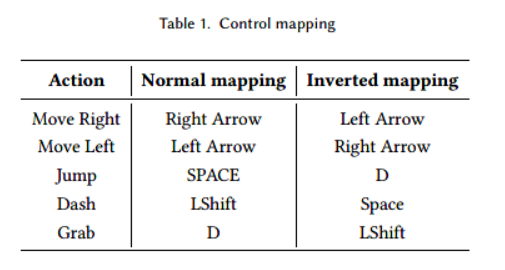
The first used a baseline “intuitive” mapping of controls determined by analysing common keyboard mappings of 14 other platformers. In this baseline configuration, jump was mapped to the space bar, dash to the Lshift key, grab to the ‘D’ key, and movement to the arrow keys. For the second round, an alternative mapping was used to investigate motor adaptation. The alternative mapping consists of the action controls rotated counter-clockwise: jump to D, clash to the space bar, and grab to LShift. In the third round, controls were reverted to the baseline mapping. These intuitive and alternative mappings are shown in Table 1.
Lastly, participants were asked to fill in a questionnaire between rounds and at the end of the study. No time limit was set for the questionnaire.
2.3 Metrics
We used the metrics gathered through the Consistency Tracker mod to determine the players’ adaptability. The metrics we gathered were performance metrics, including total time, time in each room, number of rooms completed, and error rates consisting of the number of deaths per room and total deaths. Adaptation was analysed based on the difference between the average number of deaths and the average time spent per room across rounds. Besides using in-game metrics, we wrote a Python keylogger script that recorded all key presses during each round. Additional recorded data was players’ dispositions towards the chosen keyboard layouts. Background information was also gathered, including demographic information and gaming experience. The questionnaire was built, and its data recorded and extracted using Gorilla Experiment Builder [2].
3 ANALYSIS AND RESULTS
The raw data obtained from the keylogger script and through the Consistency Tracker mod was processed by compiling the data into a singular file. All further analyses and visualizations resulting from this data were produced in R [18]. Additionally, due to the repeated measures present in the project (data is recorded from each participant over multiple rounds), a traditional linear model cannot be used, as those assume full independence of the variables. To account for within-subject variability, we applied linear mixed-effects models, with a random intercept for participants, using a threshold of |t| ≥ 2 as an indicator of statistical significance, which corresponds roughly to a threshold of p < .05.
Participants’ familiarity with games was measured by years of gaming experience and average hours play time a week. The primary fixed effect we used was average hours a week, as years of gaming experience are not an indicator for current skill.
3.1 Analysis of Survival Outcomes (Deaths)
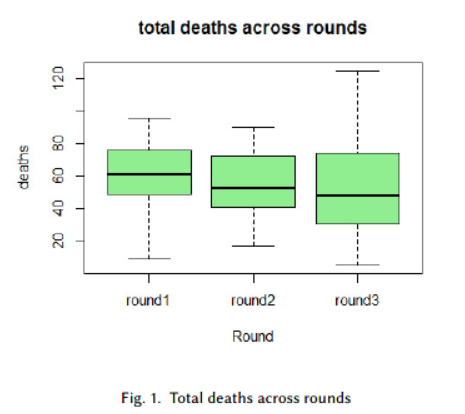
As stated earlier, one measurement we recorded was the number of deaths per participant. Figure 1 displays the average number of deaths across rounds. Although the median number of deaths decreased from Round 1 to Round 3, the variability increased in Round 3, largely due to three extreme observations.
One of our primary interests is the relationship between death counts and gaming experience. Extreme outliers were identified based on the visuals and excluded from the analysis. Figure 2 illustrates the relationship between those two factors without the outliers.
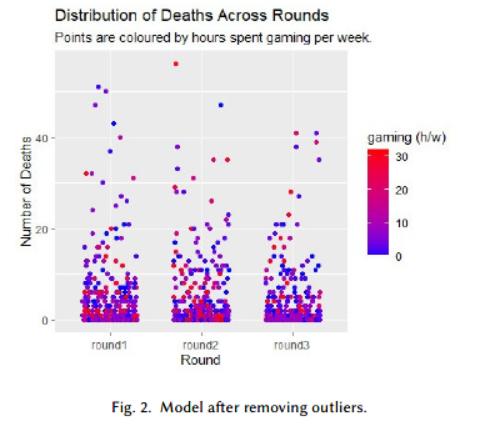
Table 2 presents the fixed-effects estimates for the model without outliers, providing a more interpretable summary of the relationship between death counts, round, and hours of gaming per week.
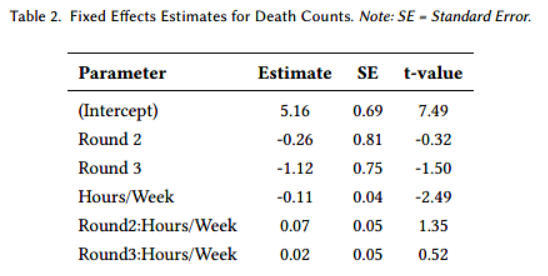
Table 2 presents the fixed-effects estimates for the model predicting death counts. The intercept reflects the expected number of deaths in the reference condition (Round 1) at zero hours per week. Neither Round 2 nor Round 3 differed significantly from Round 1, as both coefficients were negative but small and non-significant. Hours per week showed a significant negative association with death counts (𝛽 = −0.11, t = −2.49), indicating that greater weekly hours were associated with fewer deaths. The interaction terms for Round 2 × Hours/Week and Round 3 × Hours/Week were not statistically significant, suggesting that the effect of hours per week on death counts did not vary meaningfully across rounds. Overall, the findings indicate a consistent reduction in deaths with increased hours per week, with no evidence that this relationship changed across rounds.
3.2 Analysis of Completion Time
In addition to death counts, we also recorded the time each participant required to complete every room. Figure 3 displays the average completion time across rounds. As shown in the plot, completion times generally increased across rounds, without any significant variance.
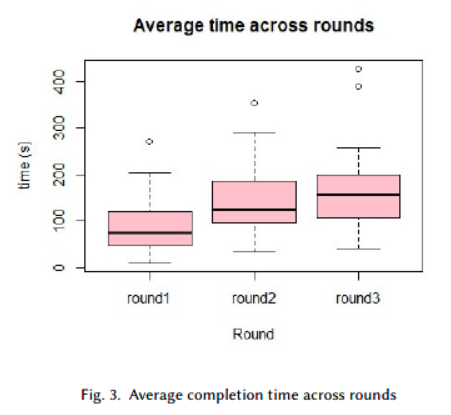
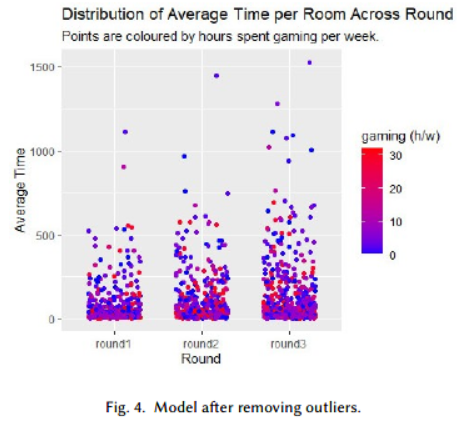
Following the same rationale applied in the analysis of death counts, we removed outliers from the completion-time data to obtain a more stable estimate of performance patterns. Figure 4 illustrates the model predictions after excluding outliers, plotted against participants’ gaming experience (measured as hours per week).
A summary of the fixed-effects estimates for the model without outliers is provided in Table 3.
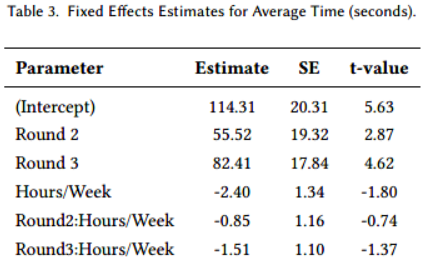
Table 3 reports the fixed-effects estimates for the completion-time model. The intercept represents the expected time to complete a room in Round 1 for a participant with zero hours of weekly gaming experience. Both Round 2 and Round 3 show significantly longer completion times compared to Round 1, with increases of approximately 56 and 82 seconds, respectively. Hours per week showed a negative but non-significant association with completion time (𝛽 = −2.40, t = −1.80), indicating a tendency for more experienced players to complete rooms more quickly, though the effect was not strong enough to reach the significance threshold. The interaction terms between round and hours per week were also non-significant, demonstrating that the relationship between gaming experience and completion time did not differ meaningfully across rounds. Overall, the model suggests that later rounds required more time to complete, but gaming experience did not significantly alter performance speed.
3.3 Analysis of Player Activity (Keypress Data)
To further examine how players interacted with the game under different key layouts, we recorded player activity by logging every keypress associated with the three main actions: jump, dash, and grab. Our aim was to determine whether altering the key layout would lead to measurable changes in player behavior. Specifically, we hypothesized that when the layout changed, participants might press more keys due to increased errors or corrective actions (e.g., pressing an incorrect key and subsequently compensating by pressing the correct one). Figure 5 presents the aggregated keypress data for each action across rounds.
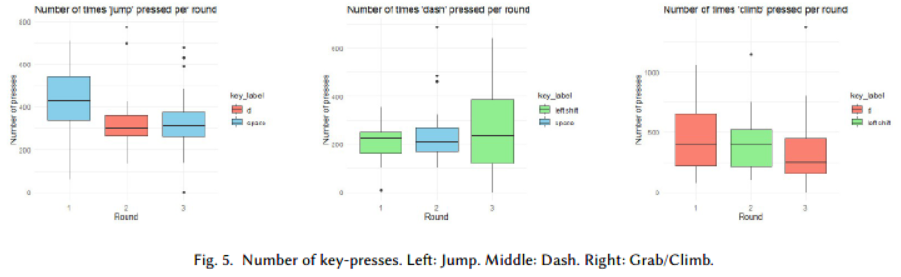
The plots indicate that changes to the key layout did not substantially influence the total number of keypresses for any of the three actions. Instead, the observed variation appears to be more strongly related to the progression through rounds and the increasing familiarity of participants with the game mechanics. For example, jump presses were most frequent in Round 1, likely because participants initially relied more heavily on this familiar action while learning the game. By Round 3, however, dash presses increased, suggesting that players had become more comfortable with the game’s movement system and began incorporating more advanced maneuvers into their gameplay.
Overall, the keypress data provide no evidence that remapping the keys disrupted player activity. Rather, the trends are consistent with a learning effect across rounds, whereby players gradually adapted to the game and diversified their use of available actions.
4 DISCUSSION
The aim of this study was to investigate whether gamers adapt quicker to new control mappings than non-gamers. Our findings suggest that the opposite is true – non-gamers seem to adapt slightly quicker to new controls than gamers. We argue this is due to the fact that gaming related motor controls are already established in gamers, and they quickly pick up new controls for a new game – as if evident by the statistically significant fewer number of deaths and less time spent in rooms on average for gamers compared to non-gamers – but because these new motor skills are quickly formed, they have more diffculty adapting to new controls. However, the moment controls were reverted back to the established baseline mapping, gamers regained their initial advantage over non-gamers. This corresponds to the findings of [23], where the re-adaptation to the visual field was nearly instantaneous.
This similarity between rounds 1 and 3 is, however, not congruent with our findings regarding time measurements. When we compare the average time per room, we see an increase in round 2, but another increase in round 3. The participants needed increasingly more time with the passing of each round, which does not align with the number of deaths as a measure of skill. We argue that this increase in time per room in each subsequent round is due to a shift in the cognitive processing of players from instinctual to conscious planning. Due to the switch in controls, which means that controls are now considered non-intuitive, gamers need to strategise more and not only start planning their moves, but also which button is associated with that move. Especially for experienced gamers who are familiar with the mechanics in platformer games and have established motor skills, the gameplay could quickly become intuitive in the first trial, but on the second trial, participants became more reliant on planning their next actions. Our experimenters noticed occasionally that participants would start verbally strategising their button sequence before performing their actions. The fact that the time spent per room increases in the third round as well strengthens our belief that the change in conditions made the participants continue playing consciously.
Previous research comparing the adaptability between gamers and non-gamers ([6] & [9]) found no initial advantage for gamers in action games. However, we have found that gamers do have an initial advantage in platformer games. We attribute this difference to the fact that platformers require certain skills that are not necessarily intuitive – one must press buttons in a certain order, often with little time between presses, with highly accurate timing. This is not a skill that is often used outside of video games by regular non-gamers and would therefore make them less adept than gamers, compared to action games, which are usually a little more intuitive for non-gamers. Moreover, previous research showed that, despite this lack of initial advantage, experience had a significant influence on the adaptability to novel motor behaviour, both in action games as well as in First Person Shooter (FPS) games [4]. As mentioned above, we have found results that are directly opposite; non-gamers showed greater cognitive flexibility than gamers. This difference in adaptability seems therefore, dependent on the game genre. Action and FPS games generally demand continuous awareness and rapid decision-making in a fast-paced environment, while platformers provide a calmer, steadier rhythm with clearer patterns and more opportunities for planning without a stress factor. We argue that the advantage regarding motor adaptation of gamers in such fast-paced games is correlated with a different kind of environment than platformer games and is therefore not applicable here.
Besides the in-game metrics that we have discussed, we also analysed the keylogger program. Our initial prediction was that when the keyboard mapping was altered in the second round, error rates in keypresses would increase. The keylogger was initially proposed to find a pattern in the timing of key presses. Specifically, to measure the number of times a participant would press the key that was previously associated with a specific action instead of the currently mapped key when intending to perform that action. Unfortunately, it was not feasible to measure this given our limitations. However, the cumulative results of key presses still provided valuable information, as we can see from figure 5 that keypresses do not drastically increase in the second round and decrease in the third.
In summary, adaptability appears to be a complex skill that is not universally applicable across different processes. The advantage of gamers and non-gamers seems heavily dependent on context. While gamers benefit from strong, well-practised motor controls in familiar and intuitive control settings, when the situation demands a rapid shift away from their established patterns non-gamers gain an advantage. Non-gamers, whose neural patterns are less strong, appear more flexible when confronted with unexpected changes in control mappings. This suggests that adaptability in video game environments is shaped not only by experience but also by the type of cognitive processing a game encourages, and that different genres can elicit different strengths in gamers and non-gamers alike.
4.1 Limitations
The study has several limitations that must be acknowledged. First, the sample size was relatively small (N = 30, with 2 participants excluded), limiting the statistical power of our analyses and increasing the likelihood that subtle effects went undetected. Second, the duration of each round (15 minutes) necessitated a compromise between allowing suffcient time for adaptation and avoiding excessive fatigue or frustration. Informal observations indicated that frustration levels varied across participants, yet this variable was not systematically recorded. Because frustration can influence both motor performance and cognitive flexibility, its absence from the dataset constitutes a meaningful limitation. Additionally, the experiment lasted approximately one hour per participant, which may have introduced fatigue-related performance effects.
4.2 Future Research
A replication of our experiment regarding frustration levels as an influencing factor is warranted. We noted during our research that there were different levels of frustration amongst participants, but we did not include frustration in our data gathering systematically. Another potential direction for future research is to investigate how the switching of controls would affect adaptation in real-world applicable scenarios. For instance operating machinery often involves controls that are prone to change, whether due to software updates or changes in hardware. Knowing what the adaptation process could look like can prove crucial for the learning and safety protocols in these situations. Finally, it would be interesting to research how verbal self-guiding and planning affects adaptation in a similar environment. We argue that participants start planning their next move when the controls are switched. Occasionally, participants started strategising verbally, stating the order in which they wanted to press the buttons. Further research could investigate whether this self-talk influences their performance and helps people adapt better to new control mappings.
5 CONCLUSION
This study investigated the impact of swapping keyboard mappings on player performance within Celeste. Specifically, we looked at how previous gaming experience influences adaptation. Previous studies suggest that experienced gamers are quicker to adapt to alternative button configurations. However, the results we have found in this study show that despite experienced gamers performing better on average with fewer deaths and less time spent, non-gamers adapted slightly better to changing the button mapping. Observations suggest that non-gamers tend to take their actions with more conscious and deliberate planning, which might cause them to perform better. Additionally, no evidence was found that changing controls increased error rate, but instead, we theorize that this could be linked to familiarity with gaming. These differences between our findings and previous studies, such as [4], could be linked to the game chosen. Within Celeste, players are able to stand still and plan certain sets of movements. However, in other genres of games, such as FPS games, players are required to rapidly think and react to situations. Nevertheless, our results indicate that gamers’ strong motor habits might hinder them from adaptation when the button mapping is different from their previously learned base.
Finally, this research on motor adaptation in the context of control mapping contributes to the wider fields of accessibility design and human-computer interaction. While the study was done within a relatively small participant pool, and there was no observed statistical significance, it addresses a pertinent gap in the existing literature. Furthermore, the patterns observed in the results raise interesting questions regarding the relationship between motor adaptation and other cognitive processes, such as planning and reasoning, which could be explored in further research.
REFERENCES
[1] 2018. Celeste. https://www.celestegame.com/
[2] A. L. Anwyl-Irvine, J. Massonnié, A. Flitton, N. Kirkham, and J. K. Evershed. 2020. Gorilla in our midst: An online behavioural experiment builder. Behavior Research Methods 52 (2020), 388–407. https://doi.org/10.3758/s13428-019-01237-x
[3] Guillermo Asín-Prieto, Aitor Martínez-Expósito, Filipe O Barroso, Eloy J Urendes, Jose Gonzalez-Vargas, Fady S Alnajjar, Carlos González-Alted, Shingo Shimoda, Jose L Pons, and Juan C Moreno. 2020. Haptic adaptive feedback to promote motor learning with a robotic ankle exoskeleton integrated with a video game. Frontiers in Bioengineering and Biotechnology 8 (2020), 113.
[4] Lorenza S Colzato, Pieter J Van Leeuwen, Wery Van Den Wildenberg, and Bernhard Hommel. 2010. DOOM’d to switch: superior cognitive flexibility in players of first person shooter games. Frontiers in psychology 1 (2010), 1515.
[5] Riccardo Galdieri, Mata Haggis-Burridge, Thomas Buijtenweg, and Marcello Carrozzino. 2020. Users’ Adaptation to Non-standard Controller
Schemes in 3D Gaming Experiences. In International Conference on Augmented Reality, Virtual Reality and Computer Graphics. Springer, 411–419.
[6] Davood G Gozli, Daphne Bavelier, and Jay Pratt. 2014. The effect of action video game playing on sensorimotor learning: Evidence from a movement tracking task. Human movement science 38 (2014), 152–162.
[7] Charles S Harris. 1965. Perceptual adaptation to inverted, reversed, and displaced vision. Psychological review 72, 6 (1965), 419.
[8] John F Houde and Michael I Jordan. 1998. Sensorimotor adaptation in speech production. Science 279, 5354 (1998), 1213–1216.
[9] Tjasa Kunavar, Niko Kroflic, Marko Jamšek, and Jan Babič. 2025. Influence of video gaming experience on motor adaptation during visuomotor and force field perturbations. Heliyon 11, 10 (2025).
[10] Laura Levy, Amy Lambeth, Rob Solomon, and Maribeth Gandy. 2018. Method in the madness: the design of games as valid and reliable scientific
tools. In Proceedings of the 13th International Conference on the Foundations of Digital Games. 1–10.
[11] Timothy P Lillicrap, Pablo Moreno-Briseño, Rosalinda Diaz, Douglas B Tweed, Nikolaus F Troje, and Juan Fernandez-Ruiz. 2013. Adapting to
inversion of the visual field: a new twist on an old problem. Experimental brain research 228, 3 (2013), 327–339.
[12] Anthony M Limperos, Michael G Schmierbach, Andrew D Kegerise, and Frank E Dardis. 2011. Gaming across different consoles: exploring the
influence of control scheme on game-player enjoyment. Cyberpsychology, Behavior, and Social Networking 14, 6 (2011), 345–350.
[13] Laura A Malone, Nayo M Hill, Haley Tripp, Daniel M Wolpert, and Amy J Bastian. 2023. A novel video game for remote studies of motor adaptation in children. Physiological reports 11, 13 (2023), e15764.
[14] Mitchell W McEwan, Alethea L Blackler, Daniel M Johnson, and Peta A Wyeth. 2014. Natural mapping and intuitive interaction in videogames. In Proceedings of the first ACM SIGCHI annual symposium on Computer-human interaction in play. 191–200.
[15] David Melhart, Ahmad Azadvar, Alessandro Canossa, Antonios Liapis, and Georgios N Yannakakis. 2019. Your gameplay says it all: Modelling motivation in tom clancy’s the division. In 2019 ieee conference on games (cog). IEEE, 1–8.
[16] Nintendo. 1985. Super Mario Bros. Video game. Nintendo; Platform: Nintendo Entertainment System (NES).
[17] Donald A. Norman. 2013. The Design of Everyday Things. The MIT Press, Cambridge, MA.
[18] R Core Team. 2025. R: A Language and Environment for Statistical Computing. https://www.r-project.org/. Accessed: 2025-12-11.
[19] Ryan Rogers, Nicholas David Bowman, and Mary Beth Oliver. 2015. It’s not the model that doesn’t fit, it’s the controller! The role of cognitive skills in understanding the links between natural mapping, performance, and enjoyment of console video games. Computers in Human Behavior 49 (2015), 588–596.
[20] Reza Shadmehr, Maurice A. Smith, and John W. Krakauer. 2010. Error Correction, Sensory Prediction, and Adaptation in Motor Control. Annual
Review of Neuroscience 33, Volume 33, 2010 (2010), 89–108. https://doi.org/10.1146/annurev-neuro-060909-153135
[21] Paul Skalski, Ron Tamborini, Ashleigh Shelton, Michael Buncher, and Pete Lindmark. 2011. Mapping the road to fun: Natural video game controllers, presence, and game enjoyment. New Media & Society 13, 2 (2011), 224–242.
[22] Maurice A Smith, Ali Ghazizadeh, and Reza Shadmehr. 2006. Interacting Adaptive Processes with Different Timescales Underlie Short-Term Motor Learning. PLOS Biology 4, 6 (05 2006), null. https://doi.org/10.1371/journal.pbio.0040179
[23] George M Stratton. 1896. Some preliminary experiments on vision without inversion of the retinal image. Psychological review 3, 6 (1896), 611.
[24] Myriam Taga, Annacarmen Curci, Sara Pizzamigglio, Irene Lacal, Duncan L Turner, and Cynthia H Y Fu. 2021. Motor adaptation and
internal model formation in a robot-mediated forcefield. Psychoradiology 1, 2 (06 2021), 73–87. https://doi.org/10.1093/psyrad/kkab007
arXiv:https://academic.oup.com/psyrad/article-pdf/1/2/73/38613435/kkab007.pdf
[25] J. S. Tsay, H. E. Kim, S. D. McDougle, J. A. Taylor, A. Haith, G. Avraham, J. W. Krakauer, A. G. E. Collins, and R. B. Ivry. 2024. Fundamental processes in sensorimotor learning: Reasoning, refinement, and retrieval. eLife 13 (aug 2024), e91839. https://doi.org/10.7554/eLife.91839
[26] Vexatos and Cruor. 2025. Lönn: Visual Map Maker and Level Editor for Celeste. https://github.com/CelestialCartographers/Loenn. Open-source level editor for Celeste, accessed: 2025-12-11.
[27] viddie. 2021. Celeste Consistency Tracker. https://gamebanana.com/mods/358978. Mod for Celeste on GameBanana. Accessed: 2025-12-11.
6 APPENDIX A: COMMON CONTROL MAPPINGS IN PLATFORM GAMES
To establish a baseline for what constitutes “natural” keyboard mappings in platformer games, we analysed the default control schemes of 14 popular platform games. Table 4 presents the most frequently used key mappings for the three core actions examined in this study: jump, dash, and grab.
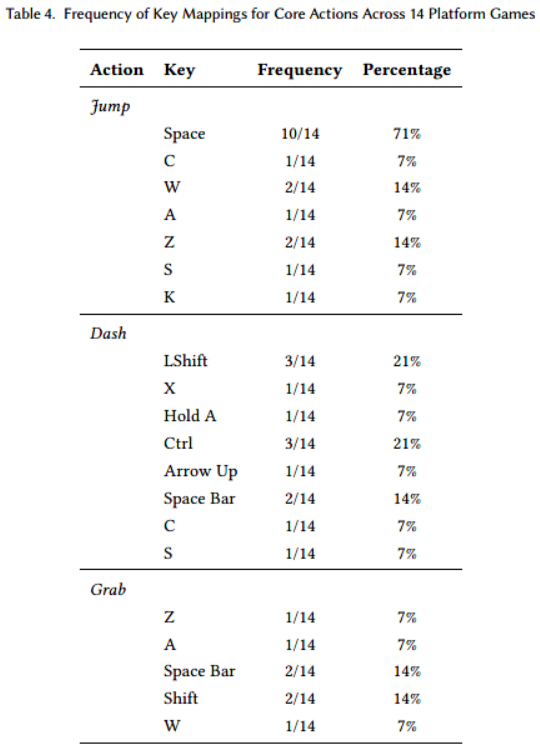
The analysis reveals that while there is a strong convention for the jump action (Space at 71%), the dash and grab actions show more variation across games. LShift and Ctrl are the most common choices for dashing (21% each), while grab actions are distributed across multiple keys with no single dominant mapping. For movement controls, 12 out of 14 games (86%) used either arrow keys or WASD, or both.
6.1 Baseline Mapping Reasoning
Based on this analysis, our baseline “intuitive” mapping for round 1 was designed to align with the most common mappings:
Jump: Space Bar (most frequent at 71%)
Dash: LShift (tied for most frequent at 21%)
Grab: D key (commonly used for secondary actions)
Movement: Arrow keys (supported by 86% of games)
This configuration ensures that experienced players would find the controls relatively familiar, while providing a neutral starting point for all participants in the study.
6.2 Games Analyzed
The following 14 platformer games were included in the control mapping analysis:
(1) Celeste
(2) Sonic Mania
(3) Rayman Legends
(4) Prince of Persia: The Sands of Time
(5) Dead Cells
(6) Guacamelee! Super Turbo Championship Edition
(7) Ori and the Will of the Wisps
(8) Hollow Knight
(9) Speedrunners
(10) Ultimate Chicken Horse
(11) Battleblock Theater
(12) Shovel Knight
(13) Noita
(14) Ori and the Blind Forest
These games represent a diverse range of platformer genres to ensure a comprehensive overview of mappings.